A Cold Air Problem
by Larry
(Ca)
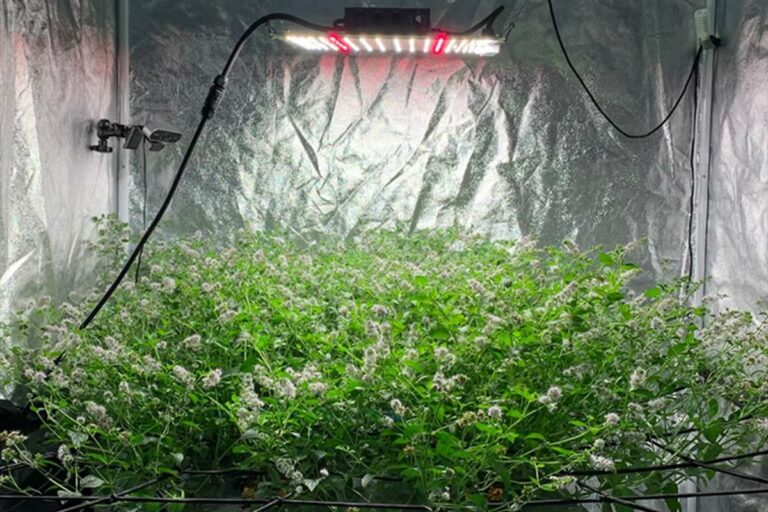
I built a new grow room outside my home. It is very cool and I thought it was ready to go with separate rooms for veg and flowering, a serious exhaust fan built in during construction, and vents for intake the right size. I was looking at this as a builder. Problem is, the flowering room is 9'x 9'x 9' with a 2'x 2' intake vent.
It is cool outside and I have a heater on for temp control, but the exhaust fan sucks in cold air. The air temps are a battle, and I found white powder mold on some of the plants...how do I fix this? you can see me at
paradisehydro.yolasite.com
thank you for any advice, Larry.
Answer: Larry- I must say, I am very impressed by your grow room project. Excess heat is so often a problem in grow rooms, many people don't realize that too little heat can also be a big problem. There is no doubt the cool temperatures are causing (or at least contributing to) your problem with the powdery mildew.
First thing- if your 2'x 2' air intake vent is "always open" to the outside, such as a louver style vent, you may want to modify it for use during the cooler months. Discount Hydroponics has a 6 inch intake vent with a "shut off" flap and a solenoid- the solenoid controls the opening and closing of the flap in the intake and is wired to the thermostat controlling your exhaust fan. The flap is normally closed, except when your exhaust fan kicks on (at which point the solenoid opens the flap to allow air intake during the exhaust cycle).
I noticed in the video that your grow room is insulated. This is a plus. When HID lights are left on inside an insulated, enclosed space, it should lead to steadily increasing temperatures. You have a lot of air space in your grow room, so this might take a while to warm up when the lights first kick on. Obviously, once the lights go out for the night you may need an alternate source of heat (such as your heater) if it is cool outside. While your lights are on, however, you may be able to get away without using it. The key is how you manage your ventilation.
Ventilation in a grow room serves a few purposes. Removing old air (and bringing in new) usually lowers the temperature in the garden, lowers the humidity in the garden, and keeps the CO2 levels in the room from dropping to a point where the plant growth stops. If you are NOT supplementing with CO2, you should indeed exchange the air in your grow room from time to time. Other than that, there is no reason to run your exhaust fan unless the temperature at plant level goes above 75 or 80 degrees.
If the humidity goes above 60 or 65 percent, you may also want to run the exhaust fan....but there are other options for controlling humidity than running your exhaust fan. Warmer air can hold much more water vapor than cooler air, so as the temperature in your grow room warms up (to where it should be) you should notice the humidity coming down a little bit.
When your lights go off for the night, the opposite is true- as the air temp cools, it can no longer hold as much water vapor....the humidity begins to rise until the air in the room is completely saturated and the only place for the water vapor to go is to condensate out of the air and onto the plants and walls. This action shortly after "lights out" may also be contributing to your powdery mildew.
The other option for controlling the effects of humidity (besides exhausting the grow room) is to increase the air movement around the plants. Plants can tolerate higher and higher humidity levels without any ill effects as long as the air movement in and around the plants becomes more and more vigorous. In a way, the increase in humidity hampers the plants ability to breathe normally, while the increased air circulation helps the plants breathe a little easier.
For the time being, let's assume that you will not have any problems with humidity as long as you get your temperature up and increase your air circulation around the plants (a couple of 12 inch oscillating fans should work nicely). Let's also assume that CO2 will not be a huge problem because you have a lot of air space in your grow room....and also because every building "breathes", or slowly exchanges it's air with the outside. So (for the moment) the only reason you should need to run your exhaust fan is if the temperature in your grow room becomes too high.
Now, put your exhaust fan on a thermostat and set it to kick on whenever the temperature under the lights (at plant level) reaches 75 or 78 degrees. Since you are fighting the coldness, it is ok to let the temperature go to 78 degrees before you kick the exhaust fan on (in the summer, that will be a different story). This is the big test- hopefully, with your lights on, the temperature in your grow room will climb slowly to the point where your exhaust fan kicks on....or at least to the point where it keeps the room between 65 and 75 degrees.
Your thermostat should be set to shut off the exhaust fan once temperatures drop to 65 or 68 degrees. Any time temperatures drop below 65 degrees, you will need to run your heater to maintain 65 degrees in the grow room. This will likely be the case when the lights are out, during the first hour or two after your lights kick on, or whenever it gets really cold outside and the heat from your lights is just not enough to warm the space.
Assuming the veg area is also lit by HID light, and assuming both the veg AND flowering areas are exhausted simultaneously by the same big exhaust fan, there is only one other suggestion I can make in regards to your situation....during cooler months you may want to re-circulate air back and forth between the veg area and the flowering area. The heat from the veg area can be used to warm the flowering area (somewhat) when the lights are off in the flowering area, and having the veg area and the flowering area at the same temperature will prevent you from having additional HVAC problems in your grow room....or worse yet, having to run two separate systems because your veg area is always a different temp than your flowering area.
I sure hope this helps you out Larry- and Happy Growing!