Grow Room Humidity Issues?
by Joe
(Washington state)
I already know how to successfully combat excessive heat and humidity in a closed sealed system with C02 injection and AC cooling. However, I wish to avoid using CO2. So, my question is....how does one control humidity without having a sealed room?
A) If I am using a powerful vent fan to vent away humidity and heat, then I must replace this air being exhausted with a constant flow of air from outside. However, here in Seattle, the air outside is often over 80% humidity. So I am essentially exhausting air that is 70% humidity to replace it with even more humid air from outside.
B) If I draw my fresh air from indoors then I will be wasting all the heat in the house, as my home heater will be constantly going to replace the heat being blown out of the grow room exhaust at 800 cfm.
Looking forward to your tips....Joe.
Answer: Joe- that is an excellent question. In a grow room that is not sealed, you certainly must exhaust whenever the temperature gets too high....but the same is not true about humidity. The key to this problem is understanding WHY high humidity is a problem, which involves understanding just how your plants breath.
Plants breath from tiny holes in the under-sides of the leaves. As a plant exhales Oxygen and water molecules, it allows the plant to pull in water molecules (and nutrients) from the roots. Plants, obviously, do not have lungs. This is why air movement (air circulation) around the plant is so important. As a plant "exhales" a molecule of water vapor, it relies on air movement to remove the water vapor (and Oxygen) from the surrounding plant tissue (allowing the plant to both breath and eat at the same time).
Without significant air movement around the plant the Oxygen and water vapor tend to hang in the air around the plant tissue, suffocating the plant. This can lead to dead spots, which then lead to fungus and mold problems that can wipe out a whole crop overnight.
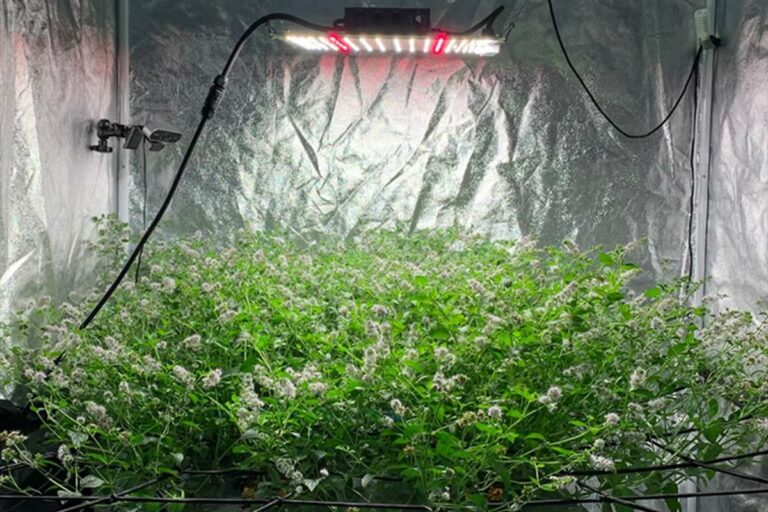
A lack of air movement is not the only condition that makes it hard for a plant to breath properly. Some plants grow very dense when flowering, and this creates a big problem for the plant tissue on the inside of a dense mass. The bigger and denser the mass, the more of a problem there will be with providing adequate air exchange to the center of the mass. This is why mold and fungus problems usually start on the INSIDE of a large, dense flower cluster (or other similarly dense mass).
The third thing that makes it hard for a plant to breath properly is high humidity. The higher the humidity, the more difficult it is for the next molecule of water vapor to evaporate into the air from the plant. This has the same effect as having too little air circulation. Consequently, the effects of high humidity can be made practically irrelevant by increasing the air movement in and around the plants in your garden.
So, the short answer to your problem is to make sure you have plenty of 12 inch oscillating fans in your garden. Then, you only need to exhaust the garden when your temperatures get too high, and you don't need to worry about using humid air from outdoors. However, you should bear in mind that you are walking on the edge here....any other factors can still tip the balance and spell disaster.
You certainly do NOT want any fungus gnats in or around a high humidity garden (filter your air intake), and you have to pay special attention to the garden immediately after the lights go out for the night. Warm air holds more moisture than cool air. When the lights go out for the night, your grow room will begin to cool. As it cools, the air can no longer hold as much moisture, and the excess water vapor begins to condense out onto the walls of the grow room and (more alarmingly) onto your plants.
Do anything you have to do to keep this from happening. You may need to add supplemental heat (after lights out) to keep the condensation from happening, or you may need to run a dehumidifier for an hour or two after lights out....or simply keeping your exhaust fan running constantly for an hour might prevent condensation as the room cools down to a stable temperature for the night.
How ever you decide to approach the problem, vigilant observation is your best friend. At the first sign of a humidity problem, you need to make some correction before it leads to dead spots. Once you have a dead spot, the other dominos will fall fast (fungus and mold). And always make sure you have enough air circulation around every plant....especially the dense ones! I hope this helps Joe, and Happy Growing!